



In this article, we take a look at money market funds for every stage of the business life-cycle
Famously, many of today’s largest and most successful businesses were founded in a garage. In spare moments between tweaking algorithms to maximise campus buzz, the founders wonder whether the seed cheque that has just cleared is safe where it sits.
Elsewhere, the treasury team at a new publicly listed behemoth with an addressable market in the tens of trillions of dollars is tasked with adequately managing and diversifying IPO proceeds big enough to take down a US Treasury bill auction.
In the business district, a scale-up’s first finance hire is trying to make a Series B funding round last three years.
A few floors up a fintech payments firm is reconciling customer money it is legally required to protect.
On an out-of-town campus, a multinational treasury operation is cash-pooling the proceeds of its latest multi-tranche debt issue and investing them across six currencies before lunch.
Five companies, all operating today, with very different balances and teams, yet the same underlying question: how do we manage our cash, maintain access to it when needed while still earning a return?
Security, liquidity, yield, in that order
Whatever stage of the business life-cycle, sound cash management rests on a hierarchy that does not change. Security first: the aim is to preserve your money until you need it. Liquidity second: it must be available the day you need it, not tomorrow or next week. Yield third: a return is welcome but never prioritised at the expense of the first two.
A money market fund is designed around this hierarchy. It is a pooled, professionally managed portfolio of short-dated, high-quality instruments, including treasury bills, commercial paper, certificates of deposit, reverse repurchase agreements and other money market securities. Many funds offer same-day dealing, subject to dealing cut-off times and fund terms, and seek to deliver returns that reflect prevailing short-term cash rates. By holding instruments from multiple high-quality issuers, a fund can diversify counterparty exposure, while regulatory and portfolio-management constraints govern maturity, credit and liquidity risk.
The seed-stage start-up
The cheque has just cleared. For the first time, the bank balance has a comma in it, and it belongs to investors, not to the founders. Balances are still small, a single current account does most of the work, and a money fund is not yet front of mind.
What matters here is less product selection than mindset: treating cash as an asset to manage, a decision to own and a process to implement. The founder’s high-street account is convenient, but leaving everything with one bank creates a single-counterparty exposure. By establishing sound policies, responsibilities and habits early, the company lays the foundations for more sophisticated treasury operations later.
IN PRACTICE
Separate investor cash from day-to-day operating cash, and make sure a named person owns the decision about where the money goes.
The venture-backed scale-up
A Series A, B or C funding round has just landed, and the cash must now last for years. Lose access to it – or lose part of it – and a company can fail despite a full order book and a good product.
The job here is narrow: aim to preserve the money and keep it available. Runway cash in a government or prime-style money fund can earn a market return while staying redeemable the same day for payroll, suppliers and growth spend. Critically, it spreads the balance across many high-quality issuers instead of leaving it with one bank.
Diversification is not a slogan; it is a structure. Depending on its strategy and mandate, a money market fund may hold securities from dozens of issuers.
THE SVB LESSON
When Silicon Valley Bank failed in March 2023, the start-ups and venture-backed firms that had parked significant portions of their runway in deposits at a single specialist bank faced considerable uncertainty. In the days that followed, some regional banks experienced deposit outflows, while government money market funds saw increased inflows.
The lesson is not that banks are inherently risky, it is that concentration matters. A bank deposit typically represents exposure to a single institution, while a money market fund can provide exposure to a diversified range of high-quality issuers. For a company whose survival depends on its runway being intact, diversification of counterparty risk is an important consideration.
When a scaling company asks itself “deposit, direct securities, or a fund?”, the trade-offs line up like this. None is universally best; the right answer depends on the size of the balance, your operational capacity and your risk appetite.
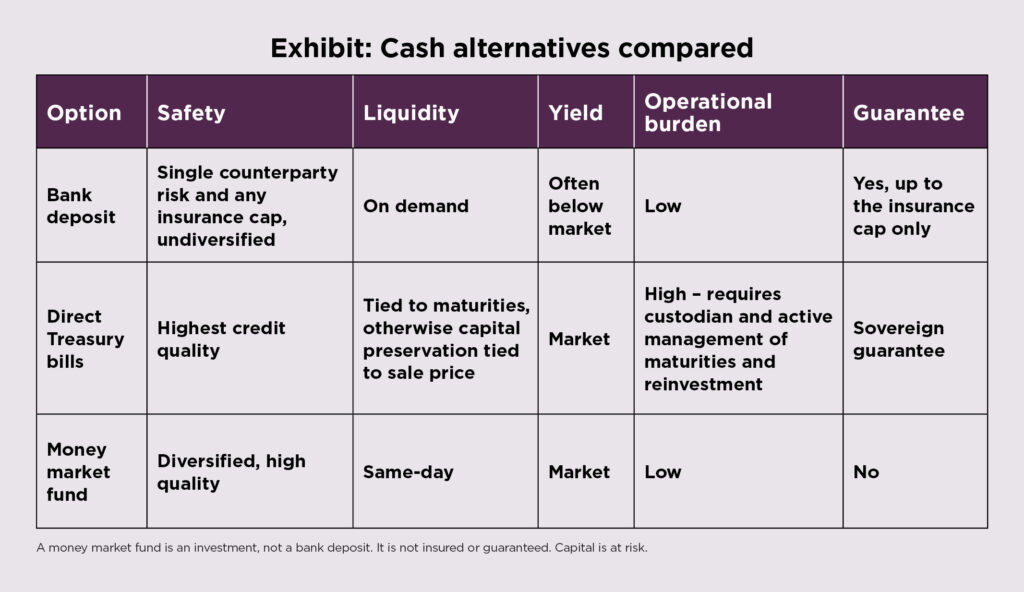
IN PRACTICE
Hold enough in same-day instruments to cover at least the next two payrolls plus a buffer; use a money fund for core runway; know the fund’s daily and weekly liquidity minimums and its largest holdings before you buy; and cap how much runway sits with any single bank.
The growth company building a treasury
Revenue is real, headcount is into the hundreds, and someone has “treasury” in their job title. The cash that used to live in one account now needs a policy.
This is where the investment policy statement is written and cash is divided into buckets, operating cash needed within days, reserve cash needed within months and strategic cash that can remain invested for longer, each with its own horizon, limits and approved instruments. Money market funds can play a role in the operating and reserve layers, where same-day access and capital preservation are priorities. The infrastructure changes too: a single-bank relationship may give way to multi-fund portals that aggregate funds from several managers behind one sign-on, with automated settlement, look-through reporting and treasury-system integration. In fast-growing payments and fintech businesses, operating cash increasingly connects to funds through specialist platforms and applications.
Payments and electronic-money (“e-money”) firms form a distinct and instructive segment. For them, money market funds are not merely a home for surplus cash; regulatory safeguarding or client-money obligations may prescribe how and where relevant funds can be held or invested.
MONEY FUNDS AND SAFEGUARDING: HOW THE RULES DIFFER ACROSS JURISDICTIONS
Payment institutions and e-money firms hold balances that belong to customers rather than to the firm. Safeguarding regimes therefore seek to keep relevant funds separate from the firm’s own money and better protected if the firm fails. The permitted methods differ by jurisdiction and may include segregation, insurance or a comparable guarantee; where investment is permitted, eligibility depends on the applicable local rules. Firms should confirm the current requirements and the eligibility of any -proposed money market fund with local legal and regulatory advisers.
Under the Electronic Money Regulations 2011 and the Payment Services Regulations 2017, firms subject to the safeguarding requirements may use segregation, an insurance policy or comparable guarantee. From 7 May 2026, the FCA’s strengthened supplementary regime introduced requirements including daily checks, reporting and, subject to applicable exemptions, annual safeguarding audits. The precise treatment of particular assets or arrangements should be confirmed against the current FCA rules and guidance.
Under the second Payment Services Directive (PSD2) and the E-Money Directive, relevant funds must be safeguarded using methods permitted by the applicable national implementation. The PSD2 review reached political agreement in November 2025, but local requirements and implementation remain important. Eligibility of specific assets and fund structures should therefore be confirmed jurisdiction by jurisdiction.
There is no single federal rule; e-money-style activity is licensed state by state as money transmission. State laws require licensees to back customer liabilities one-for-one with “permissible investments”. Most states, and the industry’s Money Transmission Modernization Act model law, count money market funds among them – California, for example, expressly permits shares of funds operating as money market funds under the Investment Company Act.
Under the Payment Services Act 2019, major payment institutions must safeguard customer money, principally by segregating it and obtaining an undertaking or guarantee from a bank or prescribed institution, alongside daily reconciliation and reporting to the local regulator. The emphasis sits more on the bank-guarantee model than on investment in funds, illustrating how the permitted methods – not just the paperwork – differ by market.
IN PRACTICE
Write the investment policy statement before you need it, not after a scare; set explicit single-fund and single-counterparty limits and a minimum same-day liquidity floor. Where possible, set global guidelines and limits which are then fine-tuned based on local rules and company culture and requirements.
The capital-markets issuer
The company is now big enough to borrow in capital markets and finds itself on both sides of the money market at once. To fund working capital, it runs a commercial paper programme, and money funds are among the largest buyers of corporate commercial paper, so the same market that holds the company’s cash also helps finance it.
When it issues a bond, the proceeds land in a single lump that need to be managed with liquidity and capital protection in mind until they are drawn down for the acquisition, project or refinancing they were raised for. Money market funds can be a practical option for managing bond proceeds, deal cash held pending completion, and debt-service reserves that must stay untouched but accessible.
IN PRACTICE
Match the maturity of parked proceeds to your drawdown schedule rather than reaching for yield on money you will need next quarter; keep escrow and deal cash in funds offering same-day access, where appropriate; and remember that money market funds can be both investors in corporate commercial paper and an option for managing a company’s cash.
The newly public company
The IPO has priced, and the proceeds have landed. An equity event – the listing, a follow-on, throws off large, lumpy inflows that must be preserved and mobilised over months while the orbital data centres are under construction.
Money market funds can provide the capacity, diversification, active management and transparent reporting expected of a public company. The objective is familiar from venture-stage runway management, but the scale, governance and scrutiny are materially greater.
IN PRACTICE
Agree a board-approved proceeds-management policy before the listing, not after; keep proceeds in funds that meet the company’s investment policy and liquidity and counterparty limits; and be ready to show, on demand, exactly where every tranche sits. Just as important, treat the policy as a living document. Review and update regularly.
The global enterprise
At the far end of the spectrum sits a mature, successful company: multinational and multi-currency, with a treasury function that operates as core infrastructure rather than as a collection of accounts. Cash is managed in dollars, euros, sterling and other currencies within a single framework. Money market funds remain important, while new use cases – including sustainability-focused strategies, collateral management, tokenisation and exchange-traded structures – continue to develop.
IN PRACTICE
Run one liquidity policy consistently across currencies and regions rather than letting each subsidiary improvise; consider ESG-named funds as a complement to corporate sustainability strategy; and keep an eye on developments in tokenisation, stablecoins and other digital technologies as their potential applications in treasury management evolve. Early engagement, pilot initiatives, and strong governance can help build expertise while maintaining appropriate risk oversight.
Money market funds across the business life-cycle
Seen through time, a money market fund can look like a companion that grows with a company. Seen across the stages of business evolution, it is one instrument serving the whole life cycle: a diversified cash-management option for a start-up, a runway reserve for a scale-up, a potential safeguarding asset where local rules permit, a proceeds-management tool for issuers and newly public companies, and part of the core treasury infrastructure of a multinational.
The balances may differ, but the core objectives are unchanged. Security, liquidity and yield – in that order – govern each company’s decisions. Corporate treasury must choose the form of the tool that suits the company’s stage, set limits before they are needed and never let the search for yield outrun safety and access. Do that, and the same instrument can help carry cash from the garage into space and all the way to Mars.